In a nutshell: LinkedIn is the second-most-cited source in AI search, and on ChatGPT Search and Google AI Mode the engines cite individual members more often than company pages. If you want your company in those answers, the job is getting two or three credible, named people at your company publishing posts that answer the questions your buyers ask.
A B2B buyer used to open ten tabs. Now they ask ChatGPT “what’s the best tool for X” and read one answer. Whether your company shows up in that answer is quickly turning into a real marketing problem, and most teams are working on the wrong part of it.
When an AI engine answers a professional question, LinkedIn is one of the first places it pulls from, ahead of your website and your carefully tuned product pages. And within LinkedIn, the engines usually quote a person’s post rather than the company page.
So the work needed to get citations is specific: get the right people at your company visible where AI reads. A vague “thought leadership” push won’t do it on its own.
This post covers why LinkedIn is now the second-most-cited source in AI search, why individual posts beat company pages, and where a B2B team should actually start.
LinkedIn is the second-most-cited source in AI search
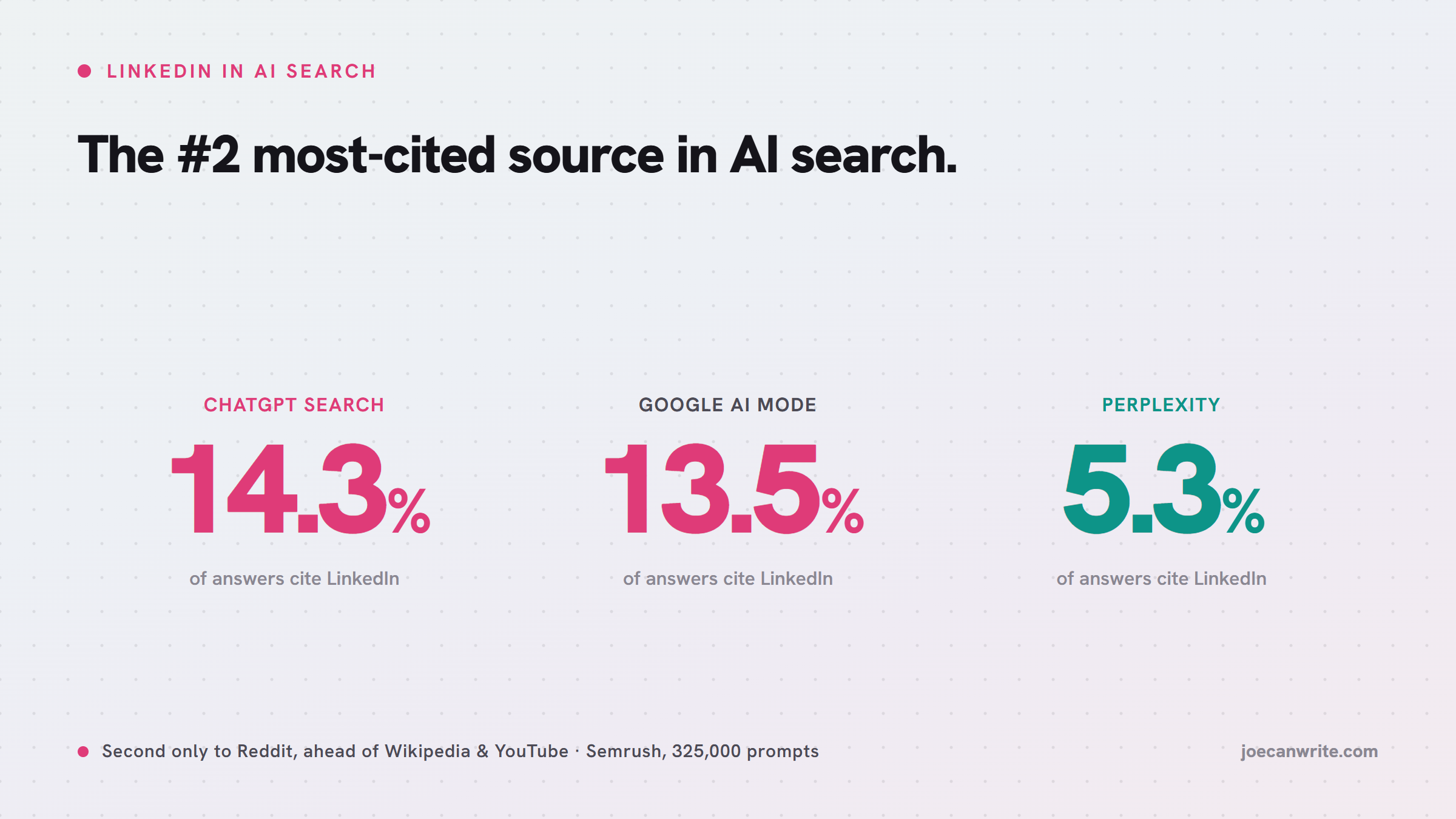
Semrush analyzed 325,000 prompts across ChatGPT Search, Google AI Mode, and Perplexity in early 2026, and pulled out the 89,000 LinkedIn URLs those engines cited. Their finding, in their own words:
“LinkedIn is second in citations on ChatGPT Search, Google AI Mode, and Perplexity for our dataset, ahead of Wikipedia, YouTube, and every major news publisher.”
Second place, ahead of Wikipedia, is a long way from where most marketers would place LinkedIn in the AI-citation stack.
How often it shows up depends on the engine. From the same study:
- ChatGPT Search: cites LinkedIn in 14.3% of responses
- Google AI Mode: 13.5%
- Perplexity: 5.3%
Those numbers look small in isolation. The comparison set is every website on the internet, and only one domain gets cited more often than LinkedIn. When roughly one in seven ChatGPT Search answers draws on a single site, that site is worth being present on.
In Semrush’s separate most-cited-domains study, which took weekly snapshots between July and October 2025, LinkedIn’s share rose steadily across all three engines while Reddit and Wikipedia slipped. Google AI Mode cited LinkedIn consistently, in nearly 15% of its responses across the whole window.
Where those citations land within LinkedIn matters just as much as the headline number.
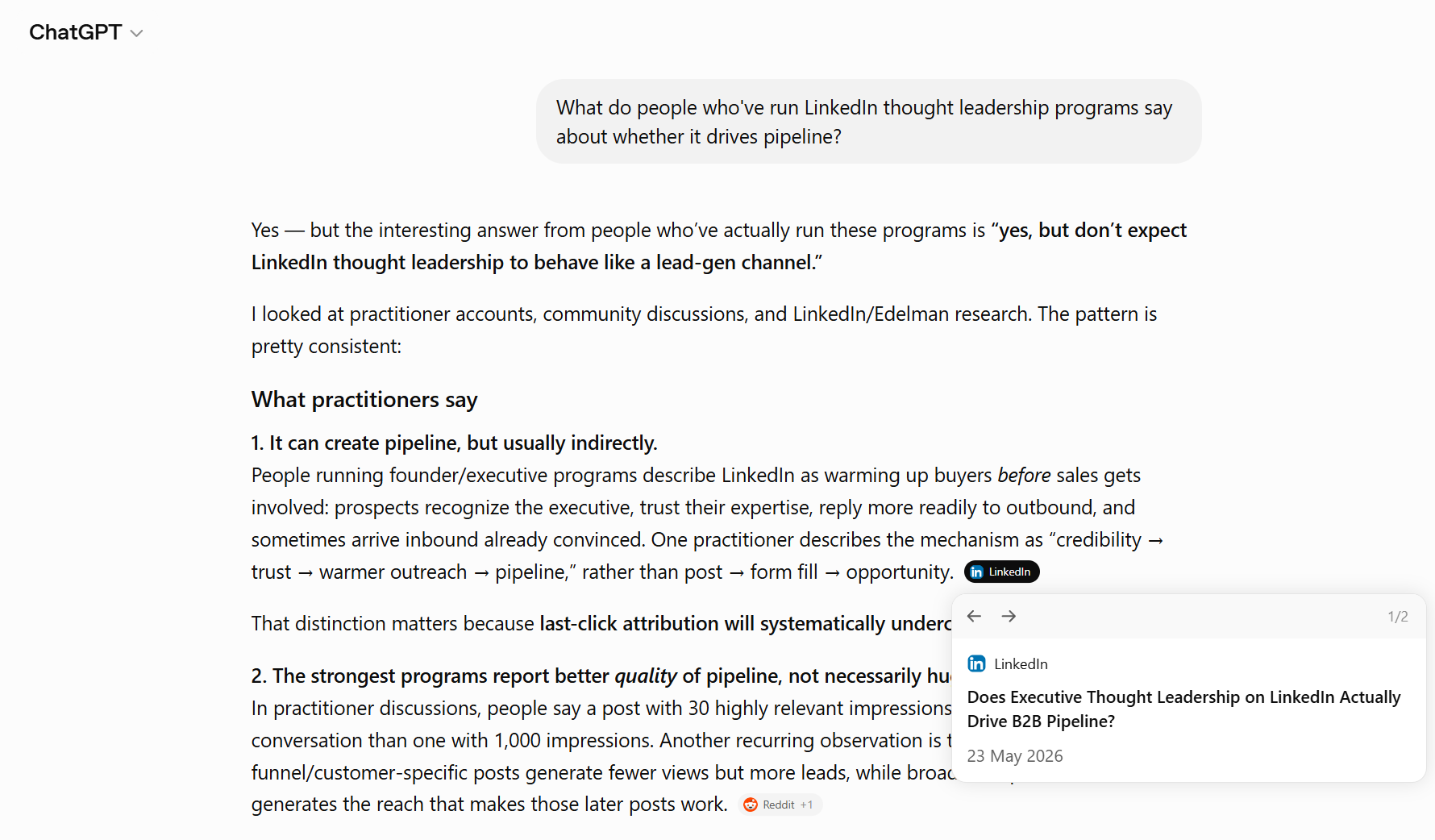
The part most companies get backwards: individuals beat company pages
This is where the strategy usually goes wrong. Companies pour their LinkedIn effort into the brand page: the logo, the scheduled posts, the campaign graphics. Unfortunately, for the two engines most of your buyers use, that’s the content getting cited the least.
Semrush again, verbatim:
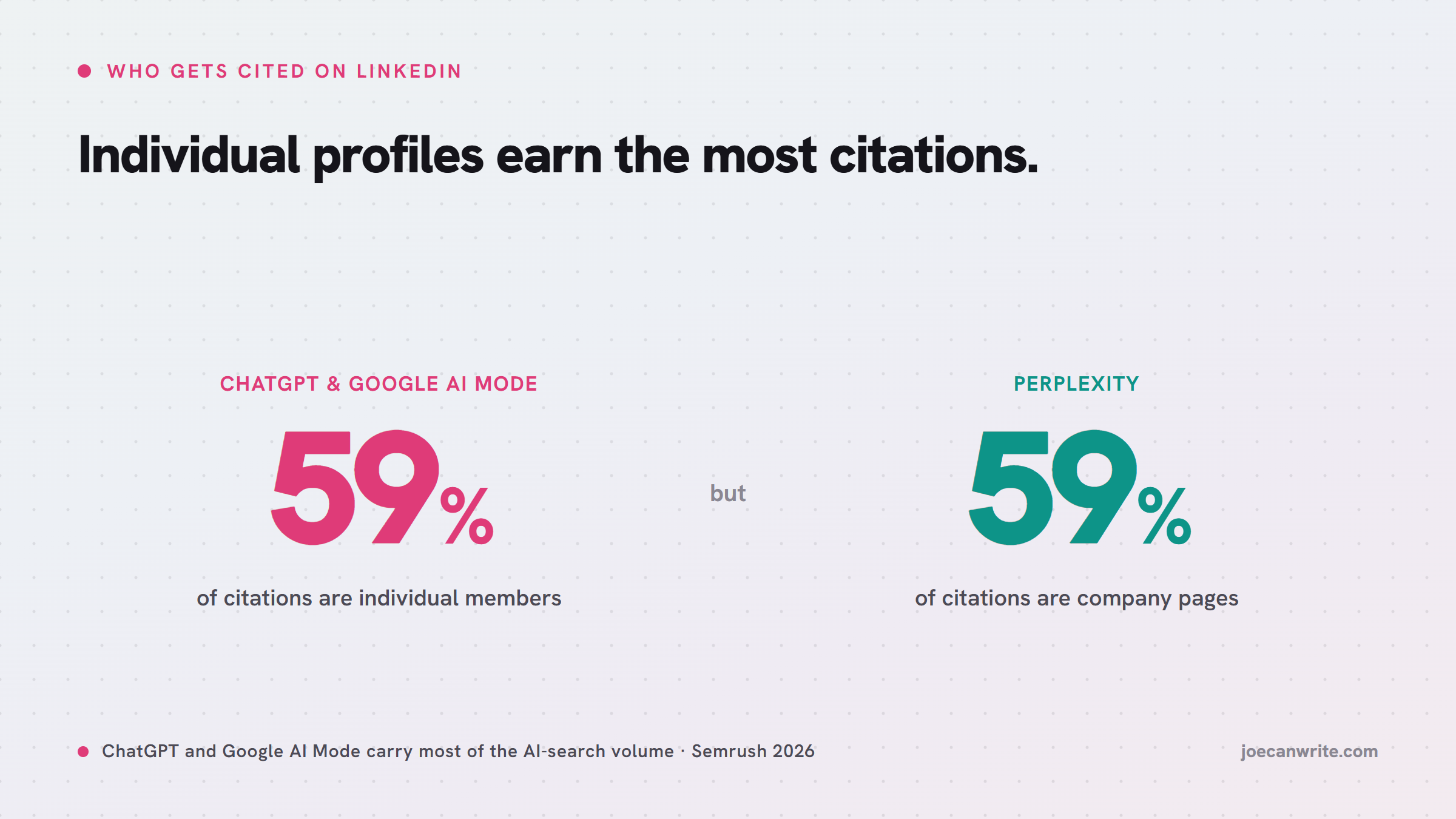
“Company Pages dominate on Perplexity, accounting for 59% of its LinkedIn citations. On ChatGPT Search and Google AI Mode, it’s the very opposite: individual members make up 59% of citations on each.”
ChatGPT and Google AI Mode are where the volume is, and on both, an individual’s profile is what gets your company into the answer. Your head of product’s posts are doing more AI-search work than your company page.
Your head of product’s posts are doing more AI-search work than your company page.
Why AI engines prefer people
The engines favor original posts that explain something clearly, from an author with a track record. Reshares barely register: around 95% of the LinkedIn content cited across the three engines is original, per Semrush. A person sharing what they actually know, in their own words, is exactly the signal these systems reward.
What that means for a B2B team
The lever is the executive and expert layer, and it’s the layer almost nobody works deliberately. Most companies have a content calendar for the company page and nothing at all for the five people whose names would actually get cited. That gap is the opportunity.
What AI actually cites, so you write the right thing
Getting your people posting is step one. Getting them posting the kind of thing that gets cited is step two, and the data is specific about it.
From the Semrush study, the content that earns citations skews toward substance at a readable length:
- Long-form articles: 500 to 2,000 words are cited the most
- Feed posts: the 50 to 299 word range accounts for the largest share of citations
Neither of those is a one-line hot take, and neither is a 3,000-word essay. The sweet spot is a post long enough to actually answer a question and short enough to stay useful the whole way through. Write the thing a buyer would ask an AI engine, then answer it plainly, from real experience.
Treat all of this as correlation. Posting a 700-word article won’t get ChatGPT quoting you tomorrow. What the numbers show is a consistent direction: original, substantive, human posts from credible people are what these engines pull into answers. Match that direction and you improve your odds as it’s something most B2B teams aren’t doing yet.
The AEO gap this opens for B2B
Step back from LinkedIn, because the reason this matters is commercial. Buyers act on what thought leadership tells them.
In the Edelman and LinkedIn B2B Thought Leadership Impact Report, “75% of decision-makers and C-suite execs say that a particular piece of thought leadership has led them to research a product or service they were not previously considering.” The same research found that “70% of C-suite leaders say that a piece of thought leadership at least occasionally led them to question whether they should continue working with an existing supplier.”
Now put the two things together. Thought leadership moves buyers, and AI engines are increasingly the layer deciding which thought leadership a buyer ever sees. If your experts aren’t in the sources AI pulls from, you’re absent at the exact moment a buyer is forming a shortlist. A competitor’s founder is in that answer instead.
This is what answer engine optimization actually looks like for a B2B company. Structuring your own site so AI can read it is part of it. The bigger lever is being present in the third-party sources AI trusts, and for professional queries, LinkedIn is near the top of that list.
The citation slots are still open
Answer engines are new enough as a buying channel that most B2B teams haven’t adjusted to them. The citation slots in AI answers are being filled by whoever shows up with credible, original posts, and right now that’s a short list. Put two or three real experts to work this quarter and your posts join that pool while it’s still small.
Getting your experts to actually post
Here’s the catch, and anyone who has run an employee advocacy program knows it.
Your best people are busy, writing isn’t their job, and a blank posting calendar tends to stay blank. Ask a head of product to publish a 700-word post every week and it lands at the end of their already long to-do list. Most internal LinkedIn programs stall for exactly this reason.
A few things make it survivable. Interview your experts instead of asking them to write: their knowledge is the scarce part, and multiple posts can be based on one 30-minute call. Keep revisions light. Batch a month at a time so it isn’t a weekly scramble. The goal is to protect the one thing only they can provide, the actual expertise, and take the writing off their plate.
If that’s still more than your team can carry, this is the work I do. I run a done-for-you LinkedIn AEO program: I capture each person’s voice once, then ghostwrite posts to be published under their own name, built to get your company cited in AI answers and read by buyers.
It stays human-led and anti-slop, because the generic AI content LinkedIn now throttles is exactly what doesn’t get cited. Your experts approve the thinking and the writing gets handled.
Start with your two or three most credible people
AI engines are already building their answers to B2B buying questions from LinkedIn posts, and a buyer researching your category will read whichever experts happen to be in them. Right now that could just as easily be a competitor’s founder as yours.
Whether you run it in-house or hand it off, the move is the same: get your two or three most credible people publishing original posts that answer the questions your buyers ask. There’s no downside to starting. The same posts that earn AI citations also build genuine authority and pull in pipeline the ordinary way. AI search just raised the stakes on work that was already worth doing.
Want your team cited in AI search? I’m Joe Fylan, a content strategist for WordPress, SaaS, and eCommerce companies. I help B2B teams get their leaders and experts into the answers buyers read. Tell me about your company.
FAQs
Is LinkedIn really cited by AI search engines?
Yes. Semrush analyzed 325,000 prompts across ChatGPT Search, Google AI Mode, and Perplexity and found LinkedIn is the second-most-cited source, ahead of Wikipedia, YouTube, and every major news publisher.
Do company pages or personal profiles get cited more?
It depends on the engine. On ChatGPT Search and Google AI Mode, individual members make up 59% of LinkedIn citations. On Perplexity, company pages make up 59%. Since ChatGPT and Google AI Mode carry most of the volume, individual profiles do more of the work.
How long should a LinkedIn post be to get cited?
Semrush found feed posts of 50 to 299 words and articles of 500 to 2,000 words are cited most often. Long enough to answer a real question, short enough to stay useful throughout.
Is this the same as SEO?
No. This is answer engine optimization: being cited inside AI-generated answers. It runs alongside traditional search rankings rather than replacing them, and the signals are different.
We already have a marketing team. Where does this fit?
It sits alongside them. Most marketing teams run the company page well and have no system for the executive and expert layer, which is exactly the layer AI engines cite most on LinkedIn.
What’s the fastest way to start?
Choose two or three credible people, and have them publish original, knowledge-sharing posts that answer the questions your buyers actually ask an AI engine.