Anthropic has now explained how Claude’s text watermark works. It announced the marking on 11 August 2026, and on 14 August published a technical explainer that answers the question its original help-center page skipped — what the mark actually is, and whether it changes the words Claude picks.
The answer is that the watermark lives in the choice between equally good words. Nothing is added to the text, there are no hidden characters, and Anthropic reports no measurable effect on the quality of what Claude writes. What it still can’t do is tell anyone whether Claude wrote your article or only tidied it up.
The dates, since that is what most people arrive looking for:
- 2 August 2026: the EU AI Act’s marking obligation applied, and Claude models launched on or after that date support marking at launch.
- 11 August 2026: Anthropic announced the watermark on its help center.
- 14 August 2026: Anthropic published the technical explainer describing how it works.
- Still to come: older Claude models get watermarking “over the coming months.” As of publication no Claude model has launched since the 2 August cutoff, the most recent being Claude Opus 5 on 24 July 2026, so nothing you are using today is confirmed as marked yet.
Updated 19 August 2026 with Anthropic’s technical explainer of 14 August, which answered the mechanism question this post originally had to leave open.
This post covers how the Claude watermark works, where the mark is thin or missing, what survives a Markdown-to-WordPress pipeline, and what a detected mark is worth if a client ever asks. If you use something other than Claude, where every major AI tool stands on watermarking is covered separately.
How the Claude watermark works
Claude’s watermark is a version of SynthID-Text, the method Google DeepMind published in Nature in 2024. Anthropic confirmed that choice in its explainer and traces the family back to a 2022 proposal by Scott Aaronson.
How the mark gets into the text
The mechanism turns on how a language model picks each word. Claude generates one word at a time, and at each step it holds a list of candidates that would all work. In Anthropic’s own example, “The weather today was cold and…” could reasonably continue with “overcast” or “grey,” and the reader gets the same sentence either way. Normally a random number settles it.
Watermarking changes where that randomness comes from. Instead of an arbitrary random number, the model uses a secret key plus the few words that came before to settle the pick. The words are still effectively random, but anyone holding the key can check whether a passage’s word choices line up with the ones Claude would have made using that key, and assign a probability from there.
What the key changes is which of the equally good options gets picked, not the model’s underlying preferences. Anthropic is explicit that this doesn’t leave Claude permanently biased toward a fixed word, since “it isn’t that the model will now always be biased toward overcast or grey,” and that it won’t reach for an obscure synonym it would otherwise never use. Anthropic does describe the effect as a “nudge” in passing, and it applies only where two options are genuinely interchangeable. That makes it a different design from the green-list scheme published by Kirchenbauer et al. in 2023, which softly promotes a randomized set of favored tokens.
Any single word choice tells you nothing. A long passage accumulates enough of them to test.
Why Anthropic is doing this
Anthropic says it is complying with the EU AI Act, which required providers to mark AI outputs in a machine-readable format from 2 August 2026. It is one of around 190 organizations that signed the accompanying Code of Practice, and the marking is not something you can opt out of. I’ve covered the law and where every other AI company stands in more detail separately.
Quotations here come from Anthropic’s 14 August explainer and from its help-center page as that page read on 12 August 2026. Anthropic says it will “update this article and publish more detailed technical guidance as it becomes available,” so the help-center wording may have moved since.
Does watermarking change what Claude writes?
John Gruber put it bluntly when the news broke: “If I ask a tool to generate text or suggest text for me, I expect that tool to generate the best possible word choices it can. Not corrupt its output for the sake of watermarking.”
Anthropic’s answer is no, and it points at evidence rather than assurance. It reports no impact on content, creativity, or readability in internal testing. In the SynthID-Text paper, DeepMind served watermarked responses to a portion of live Gemini traffic and compared thumbs-up and thumbs-down ratings, finding no statistically significant difference from the unwatermarked model. In a controlled study, human raters comparing the two side by side saw no difference in quality either.
Three further points from the explainer are worth knowing:
- Nothing is added to the text: there are no hidden characters and no invisible Unicode, so there is nothing to find and delete. Anthropic hasn’t said how much normalizing punctuation or converting formats disturbs detection, and its key reads the preceding words, so treat that as unanswered.
- No extra tokens: so no extra cost, and a negligible effect on speed.
- No identifying information: nothing in the watermark or its key can recover anything about a user, their organization, or their chats.
All three come from Anthropic’s own account. The quality claim has the DeepMind deployment and controlled study behind it; the rest nobody outside Anthropic can verify until a detector ships.
Where the mark is thin or absent
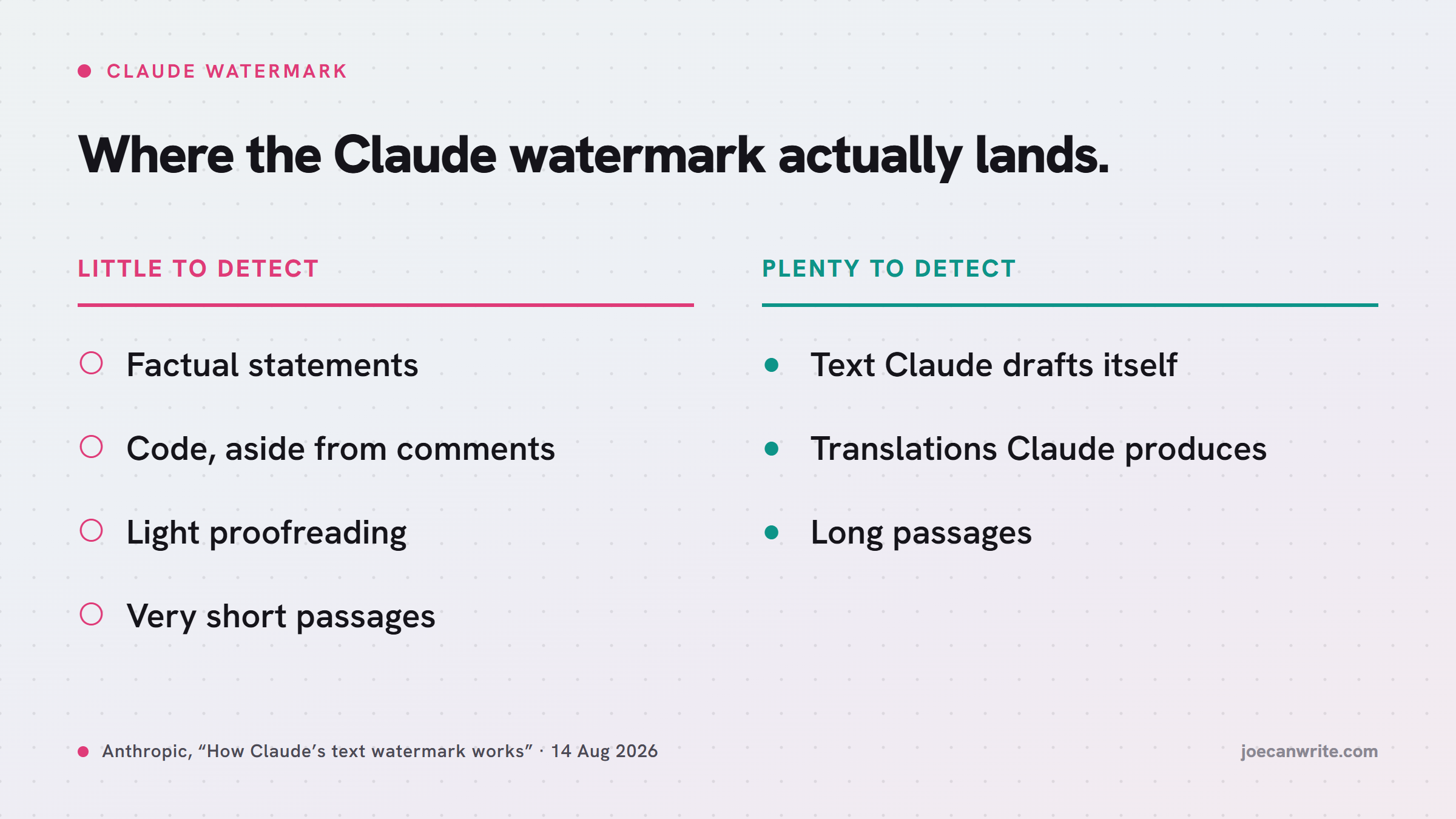
Watermarking needs choices to hide in, so it thins out wherever the right word is the only right word. This is the most useful part of Anthropic’s explainer, and it covers cases writers hit daily.
- Factual passages: Anthropic’s example is “Isaac Newton’s most famous work was called Principia…”, where “Mathematica” is the only correct continuation and the watermark has nothing to act on.
- Code: exact output is usually required, so code carries less marking than prose. Where an arbitrary choice does exist, such as in comments, the mark can be used, but Anthropic says it has “a negligible effect on the actual code produced.”
- Proofreading: when Claude edits a person’s writing, “because nearly all the words are the person’s, there’s very little (if anything) for the watermark to attach to.” Depending on length and how heavy the edit is, the changes may not be enough to make Claude’s involvement detectable at all.
- Short passages: detection works poorly on small samples, because there are fewer word choices to read. Confidence rises with length.
Translation runs the other way. Anthropic confirms that a translation produced by Claude carries a watermark, “because in this case every word is chosen by Claude.” A translated draft is generated text by this measure, whatever the original was.
Using something other than Claude? Google has been watermarking Gemini text since 2024, OpenAI has committed without saying how, Grok’s maker declined to sign the EU code at all, and Grammarly’s own detector flags its own rewrites. I’ve covered where every major AI tool stands on text watermarking in a separate post, including what it means for grammar checkers and dictation apps.
What happens between Markdown, Google Docs, and WordPress
Take the pipeline a lot of WordPress content moves through: a Markdown draft, editing rounds in Google Docs, then a paste into the WordPress editor. Anthropic says the mark “will travel with the text when it’s copied and pasted elsewhere,” and separately that it “may persist through some editing.” A Docs round trip is not pure transport, though. It swaps straight quotes for smart quotes and invites suggestions that replace words, and since the key reads the words that came before, only Anthropic can currently say whether character-level changes disturb it. What plainly matters is anything that replaces words.
Does editing remove the Claude watermark?
Anthropic now gives the two endpoints. “Light editing probably won’t remove the watermark completely; a complete rewrite where every word is replaced will.” It adds the fair point that a text with every word replaced is arguable as AI-generated in the first place.
Between those endpoints, no threshold has been published, and nobody outside Anthropic can test one, because no public detector exists yet. Anyone telling you confidently that their editing process strips the mark is still guessing.
Generated image files are a separate system: Anthropic attaches C2PA content credentials to supported file types instead of a watermark, and says some platforms may not support every marking type. That metadata survives only if each tool in the chain preserves it.
What a detected mark actually proves
Anthropic states the limit more plainly than its help center did.
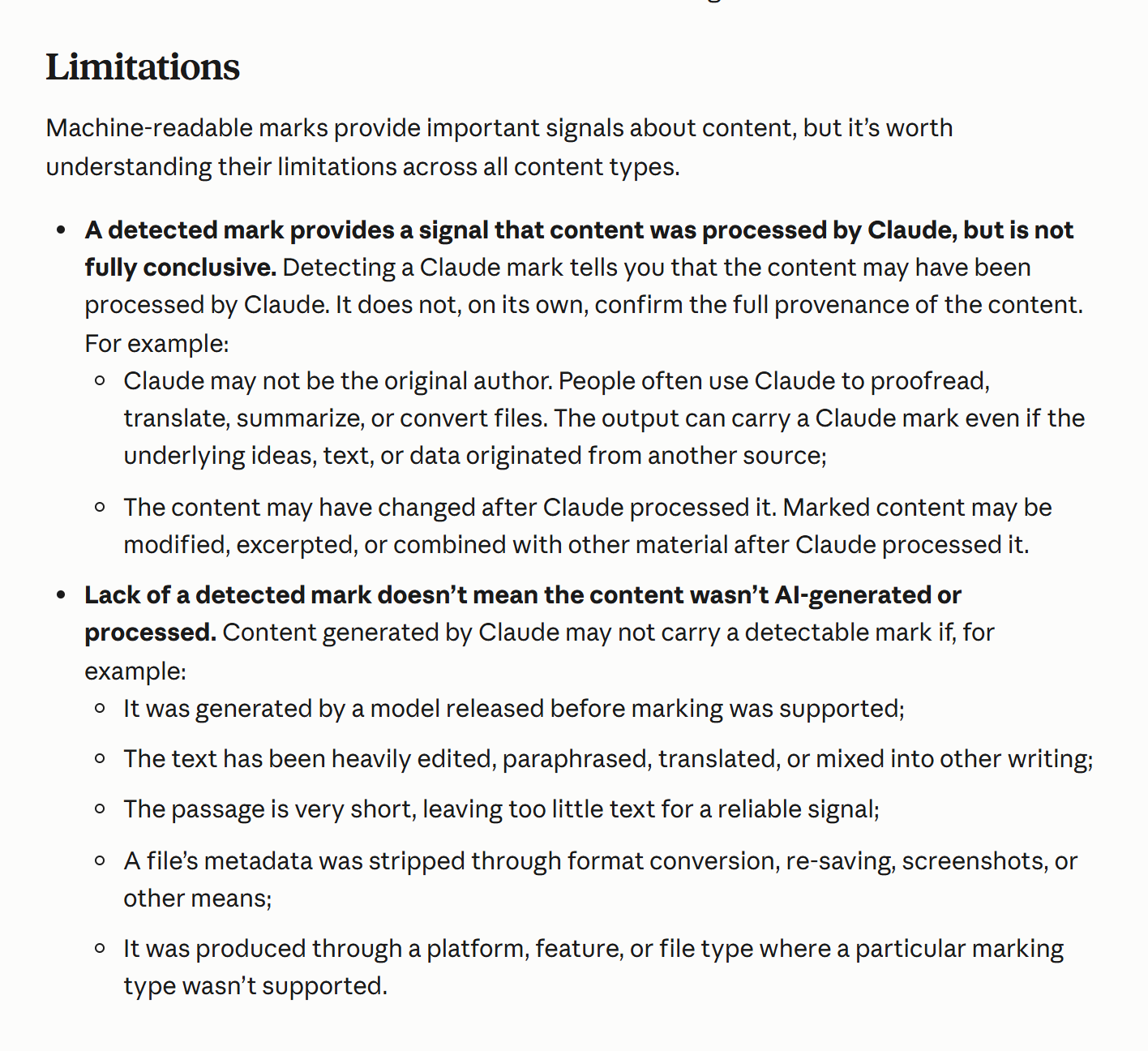
A watermark can only determine that Claude was likely involved with the content at some point. It cannot distinguish “Claude wrote this” from “Claude heavily edited this.”
Anthropic, How Claude’s text watermark works
It can’t confirm that text was human-written, and it can’t identify a different AI, since another vendor’s watermark uses a different key. Absence of a mark proves little either. The text may predate the rollout, be too short to test, or have been rewritten past detection.
The law already draws a line the mark struggles to see. Article 50 carves out AI systems that “perform an assistive function for standard editing” or that don’t substantially alter the deployer’s input or its meaning. Anthropic’s explainer gets closer to that line than the help center did, but it stops short of claiming the marking makes the distinction reliably. That remains the gap worth watching.
Ownership is untouched either way. Anthropic says the mark “doesn’t say anything about ownership or authorship, and doesn’t change a user’s rights under our terms.”
What to do about the Claude watermark
The practical impact depends on your situation, so here are the common ones:
- Your client or employer bans AI-generated work: read the actual clause. A ban on AI-generated content is a different obligation from a ban on AI-assisted editing, and the watermark can’t make that distinction on your behalf. If the wording is ambiguous, get it clarified now, while there’s no detector to force the conversation.
- AI assistance is allowed with disclosure: disclose where disclosure is owed, and keep your drafts, version history, and tracked changes. If a mark is ever detected in your work, that history is what shows who did the writing.
- You commission content rather than write it: your vendors’ pipelines matter to you now. On Anthropic’s account a light proofread usually leaves too little to register, though it says that depends on the length of the text and how heavily Claude edited it. The larger exposure sits with work that was substantially generated.
- You’re worried about Google rankings: Google’s position hasn’t changed with this announcement. Ryan Law’s Ahrefs study ran AI detection over 150,000 top-ranking pages and found no categorical penalty for AI content. Law reads the results as Google “relying on the same old hallmarks of content quality that it always has” rather than punishing AI writing as such. Pages with low or moderate AI content did draw two to three times the impressions of pages with high or very high AI content.
Across all four, weigh your exposure by how much Claude-written text survives into published copy, and note that light editing won’t necessarily clear it. Anthropic only promises removal at the point where every word has been replaced.
Most AI clauses in circulation were written when nobody could check them, and the checking is what’s arriving.
Want content that gets found and gets results? I’m Joe Fylan, a content strategist and writer for WordPress, SaaS, and eCommerce companies. If this is the kind of thinking you want behind your content, tell me about your project.
FAQs
How does the Claude watermark work?
It changes the source of the randomness Claude uses to choose between words that would work equally well. A secret key and the preceding few words settle each pick, so anyone holding the key can test whether a passage’s word choices match what Claude would have produced. It’s a version of Google DeepMind’s SynthID-Text method.
Which Claude models have the Claude watermark?
Anthropic hasn’t named one. Its help center says models launched on or after 2 August 2026 support marking at launch, and as of publication no Claude model has launched since that date. The most recent release was Claude Opus 5 on 24 July 2026. Older models fall under an EU transition period, and Anthropic says watermarking for those “will be rolled out over the coming months.”
Can editing remove the Claude watermark?
Anthropic says light editing probably won’t remove it completely, while a complete rewrite that replaces every word will. It hasn’t published a threshold between those two, and no public detector exists to test one.
Does the watermark apply if Claude only proofreads my writing?
Usually there is very little for it to attach to. Anthropic says that because nearly all the words in a proofread piece are the person’s own, the changes may not be enough to make Claude’s involvement detectable.
Can anyone check text for a Claude watermark right now?
No. Anthropic provides no public detection tool and says it “will soon be offering a watermark detection API,” without giving a date. It also plans a checker for reading C2PA credentials on generated image files.
Does a detected Claude watermark prove Claude wrote the text?
No. Anthropic’s own wording is that a watermark “can only determine that Claude was likely involved with the content at some point” and cannot distinguish Claude writing something from Claude heavily editing it.
Does using Grammarly add a watermark to my writing?
Grammarly hasn’t said. It doesn’t appear among the signatories the European Commission has named and I could find no watermarking commitment from it, and its rewrite agents run on a large language model it hasn’t identified. A spelling or comma fix changes too little for any mark to attach to, while a full rewrite means a model chose the words. Grammarly’s AI Detector is a separate mechanism that reads statistical patterns rather than watermarks, and Grammarly says it will likely flag its own rewrites.