Google has been marking Gemini text since 2024. That is the part most coverage missed when Anthropic published how Claude’s watermark works and the story landed as a Claude story.
This post covers whether there is a ChatGPT watermark yet, what each of the other major AI companies has actually committed to, and then the two categories people forget: the writing assistants they don’t file under AI, and the dictation tools that put their words on the page for them.
A note on standard of proof. Everything below is what these companies have published as of 18 August 2026. Where I say a company has announced nothing, that means I checked and found nothing, which is weaker than proof that nothing exists.
For how the marking itself works, my explainer on the Claude watermark covers the mechanism. The short version is that Claude’s mark lives in the choice between equally good words, so it survives copy and paste and thins out wherever the model had no real choice to make.
What the EU rule actually requires
The trigger is Article 50 of the EU AI Act, which requires providers to ensure AI outputs “are marked in a machine-readable format and detectable as artificially generated or manipulated.” The Act itself entered into force on 1 August 2024 and applies in stages. The penalty provisions have been live since 2 August 2025, and Article 50’s transparency obligations became applicable on 2 August 2026. That last date is the one that matters here: it is when marking stopped being a plan and became a legal requirement for anyone serving the EU market.
Around 190 organizations signed the accompanying Code of Practice on Transparency of AI-Generated Content by the end of July 2026. Eighty-two of them signed the providers’ section, which lists Aleph Alpha, Anthropic, Black Forest Labs, Cohere, Google, Meta, Microsoft, Mistral, OpenAI, and Synthesia among its signatories.
Signing the code is voluntary, and Article 50 applies either way. Breaches carry maximum administrative fines of 15 million euros or 3% of worldwide annual turnover, whichever is higher. Those are the regulator’s ceilings, and they explain why nobody is treating the deadline as optional.
One thing the law does not do is prescribe a technique. Article 50 asks for machine-readable marking, so a company could satisfy it with an embedded statistical watermark, with signed metadata, or with something else again. Two of the companies below have said which route they are taking for text. The rest have not.
Where each AI company stands
| Tool | Signed the providers’ section | Text watermark announced |
|---|---|---|
| Gemini (Google) | Yes | Yes. SynthID marks text in the Gemini app and web experience |
| Claude (Anthropic) | Yes | Yes. Method published, rollout under way |
| ChatGPT (OpenAI) | Yes | Stated intention, no method or date |
| Meta AI | Yes | None announced |
| Copilot (Microsoft) | Yes | None announced |
| Mistral | Yes | None announced |
| Cohere | Yes | None announced |
| Grok (xAI) | No | None announced |
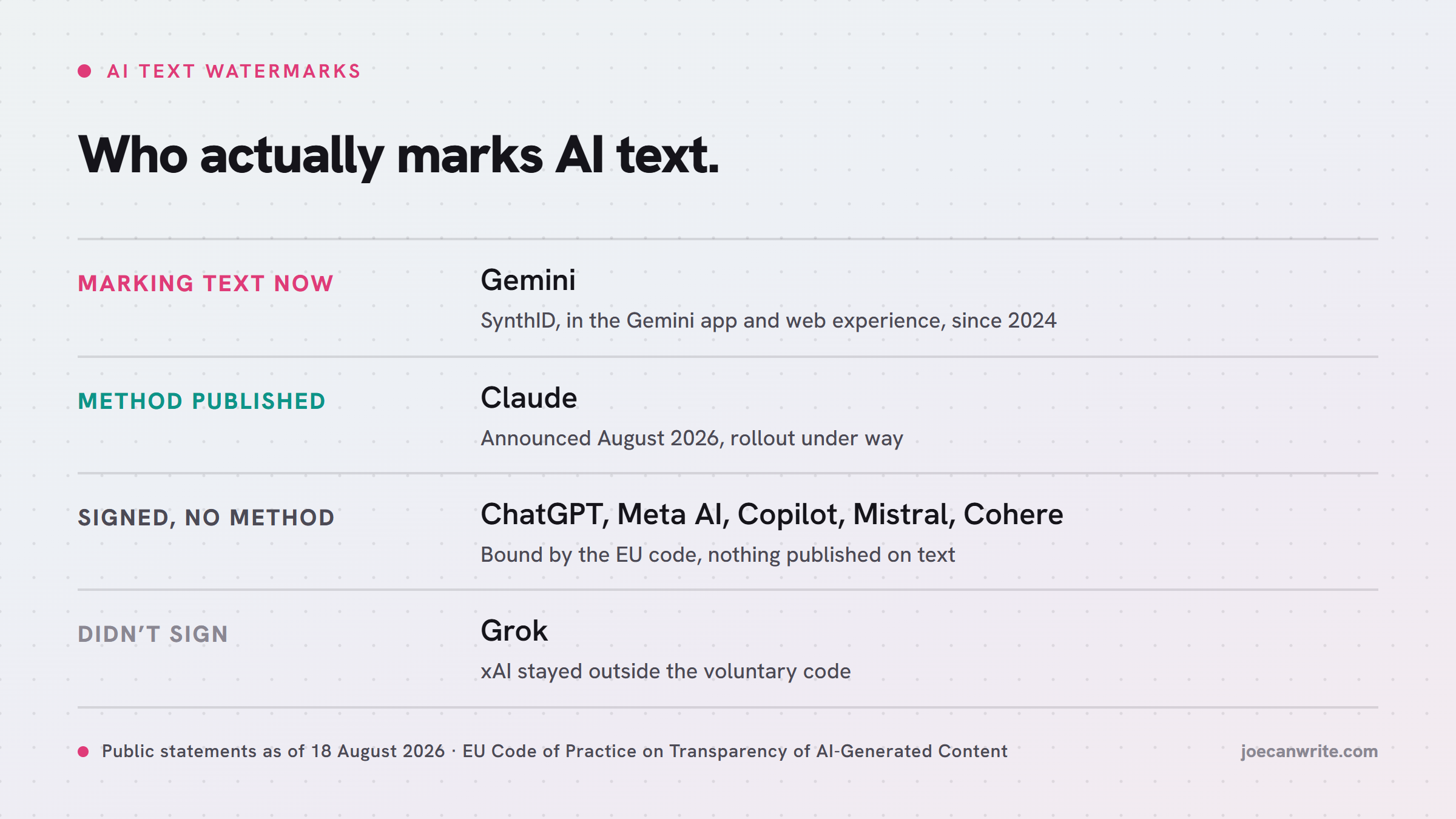
Google got there first among the mainstream assistants. DeepMind says it has “expanded SynthID to watermarking and identifying text generated by the Gemini app and web experience”, and the Nature paper describing SynthID-Text reports it deployed in Gemini at scale, serving millions of users. Note the scope in Google’s own wording: the app and web experience, which is not the same as every Gemini model, API or Workspace surface. Anthropic’s watermark is a version of the same method, published two years earlier.
Look at what those three have in common. Google invented SynthID, Anthropic has adopted it for text, and OpenAI added it to images through a partnership with Google alongside C2PA metadata. Three of the largest labs are building on one watermarking technology.
OpenAI marks other media already, but not text. Under the heading “Do you have plans to support text outputs?”, its help center says its goal is to “expand provenance signals to all modalities including text, so customers and developers have clear ways to meet their own transparency obligations as standards and tooling continue to mature”. That is a plan with a hedge attached and no date.
What OpenAI does mark is worth knowing, because it shows the shape the text version will probably take. Its own table lists images carrying both C2PA metadata and SynthID watermarks, and audio carrying SynthID. Text appears in neither row.
Four signatories have said nothing about text. Meta, Microsoft, Mistral, and Cohere all signed the providers’ section without publishing a text method. Several of them have done visible work on provenance for images and other media, which is a separate obligation and says nothing about prose. Mistral’s own documentation indicates it is still working through what the AI Act requires of its systems.
Grok is outside the voluntary code. xAI didn’t sign, and I found no separate public commitment from it on text marking. The AI Act still applies to it in the EU market, so the obligation reaches Grok whether or not it signed the pledge.
For the two methods that have been described, each uses its own key, so a detector built for Claude can’t read Gemini’s mark or the reverse. Whether anyone builds a service that runs several vendors’ detectors together is an open question. Nothing about separate keys prevents it.
Is there a visible ChatGPT watermark?
No. This is the most common misunderstanding about the whole subject, and it drives a lot of the searching: people want to find something they can see and delete, usually in Word or Google Docs.
The two text methods that have been published work statistically. They live in which words the model picked, so there is nothing to spot by eye and no hidden character to strip. If you paste output into a document, what arrives is ordinary text. That describes Claude and Gemini. Since the other companies haven’t published a method, nobody outside them can say what shape their marking will take.
Images are the exception, and it cuts the other way. OpenAI says you can ask for a visible mark on a generated image by prompting for one: “Include a visible OpenAI watermark in the image.” That is a label you request, separate from the machine-readable signals, and there is no text equivalent.
Does Grammarly count as AI?
This is the question that catches people out, because Grammarly predates the generative era and plenty of users have never filed it under AI at all. The answer depends on which part of it you use.
Grammarly does two different jobs. The spelling, grammar, and style corrections most people rely on are traditional, non-generative suggestions. The rewrite agents are generative, and Grammarly draws that line itself.
Its documentation warns that if you use those agents, “it is likely that the AI Detection agent will flag your content as AI-generated”, “because rewrites from the Grammarly, Paraphraser, and Humanizer agents come from our LLM.” Its advice to anyone worried about being flagged is to use the agents for feedback you then apply by hand.
Two mechanisms get confused here. Grammarly’s detector reads “language patterns, syntax, and complexity”, which are statistical tells in the writing itself. A watermark is a key-based check, and those are different techniques with different failure modes. Grammarly’s published detector is a pattern classifier, so it isn’t reading anyone’s watermark key.
Grammarly hasn’t published a watermarking commitment of its own that I could find, and it doesn’t appear among the signatories the European Commission has named. The practical line falls where it does elsewhere. Accepting a comma fix changes almost nothing. Accepting a full rewrite means a model chose the words, and that is generated text whatever the tool is called.
If you work under a contract that bans AI-generated content, this is the clause to check. Plenty of those agreements were drafted by people picturing ChatGPT while a Grammarly subscription ran in the next tab.
What about voice dictation like Wispr Flow?
This one surprised me, and it is the clearest answer in the post.
Wispr Flow’s own legal documents name the models behind it. Its master service agreement states: “At this time, Wispr may use OpenAI or Anthropic as Third-Party Services to generate Outputs.” Its data processing addendum lists Anthropic PBC, OpenAI, Google, Cerebras, and OpenPipe as authorized sub-processors for natural language processing and AI features.
Read that against Anthropic’s rollout and the implication is direct. Dictation output that Anthropic’s models helped produce could carry Claude’s watermark once marking reaches the models Wispr uses. Nobody has tested it, and Wispr hasn’t commented on watermarking, but the ingredients are named in its own contract rather than left to guesswork.
Whether the mark would find anything to attach to is a separate question. Speech-to-text is not the same as proofreading a written draft: the model is choosing tokens, resolving homophones, punctuating, and dropping filler as it goes, so more of the output is its choice than the phrase “your own words” suggests. How much more depends on how heavily the tool reformats, and that varies by tool and setting. The same caution applies to any dictation or note-taking app that tidies your speech, and most of them disclose far less than Wispr does.
Read your contracts before the detectors arrive
The gap worth using is the one between marking and detection, and it is narrower than it looks. OpenAI already runs a public verification tool at openai.com/verify for supported images and audio, with API access for developers added in July 2026. Google has detection for SynthID with restricted access. What nobody can check today is text: Anthropic has no public detector for its mark, and OpenAI has no text signal to detect in the first place.
So written work is effectively unauditable for now, and the tooling around it is arriving faster than the text marking is.
Two things are worth doing while it lasts. Read what your client agreements actually say about AI, and settle whether “AI-generated” in those clauses is meant to reach a grammar checker, a dictation app, or only a chatbot draft. Then keep your drafts and version history, because that is the evidence that supports an account of who wrote something, whatever any detector eventually reports.
The dictation app nobody thinks twice about turns out to run on Anthropic and OpenAI.
Want content that gets found and gets results? I’m Joe Fylan, a content strategist and writer for WordPress, SaaS, and eCommerce companies. If this is the kind of thinking you want behind your content, tell me about your project.
FAQs
Does ChatGPT watermark text?
Not yet. OpenAI’s help center says its goal is to “expand provenance signals to all modalities including text … as standards and tooling continue to mature,” with no method and no date given. It does already mark images with C2PA metadata and SynthID watermarks, and audio with SynthID, so text is the gap rather than the whole picture.
Is there a visible ChatGPT watermark in Word or Google Docs?
No. There is no visible mark, no hidden character, and no document setting that reveals one. The two published text-watermarking methods are statistical, living in which words the model chose, so there is nothing to see or delete. Images are different: OpenAI says you can ask for a visible watermark on a generated image by prompting for one.
Does Gemini watermark text?
Yes. Google DeepMind’s SynthID marks text from the Gemini app and web experience, and the Nature paper describing the system reports it deployed at scale since 2024. Google’s wording covers the app and web experience rather than every Gemini surface.
Does Grammarly count as AI?
Partly. Its spelling and grammar corrections are traditional, non-generative suggestions, while its rewrite agents come from a large language model. Grammarly’s own documentation says it is likely that its AI Detector will flag content produced by those rewrite agents.
Does Grok watermark text?
Not that xAI has announced. It declined to sign the EU Code of Practice, and I found no separate public commitment from it on text marking. The AI Act’s transparency obligations still apply to it in the EU market.
Does voice dictation like Wispr Flow count as AI?
Wispr Flow’s master service agreement says it “may use OpenAI or Anthropic as Third-Party Services to generate Outputs,” and its data processing addendum names Anthropic, OpenAI, and Google as sub-processors. Dictation output could therefore carry a vendor’s watermark once marking reaches those models, though nobody has tested it.
Can you remove an AI text watermark by editing?
Anthropic says light editing probably won’t remove its watermark completely, while a complete rewrite that replaces every word will. It hasn’t published a threshold between those two, and there is no public detector for its mark to test one against.